


Technology has become the backbone of every modern business, creating complex IT ecosystems that must keep operations running smoothly.
While these technologies improve productivity and business agility, they also make IT management more challenging, with IT teams often dealing with thousands of alerts, multiple monitoring tools, increasing infrastructure complexity, and rising user expectations.
Traditional IT operations were designed for simpler environments, so they now struggle to keep up with the speed and scale of modern digital businesses.
This is where Artificial Intelligence for IT Operations (AIOps) bridges that gap. By combining artificial intelligence, machine learning, automation, and analytics, AIOps enables organisations to monitor systems intelligently, identify issues faster, automate routine tasks, and improve overall service reliability.
In this blog, we’ll explore why AIOps has become the missing link in modern IT operations and how it helps businesses move from reactive problem-solving to proactive IT management.
What is AIOps?
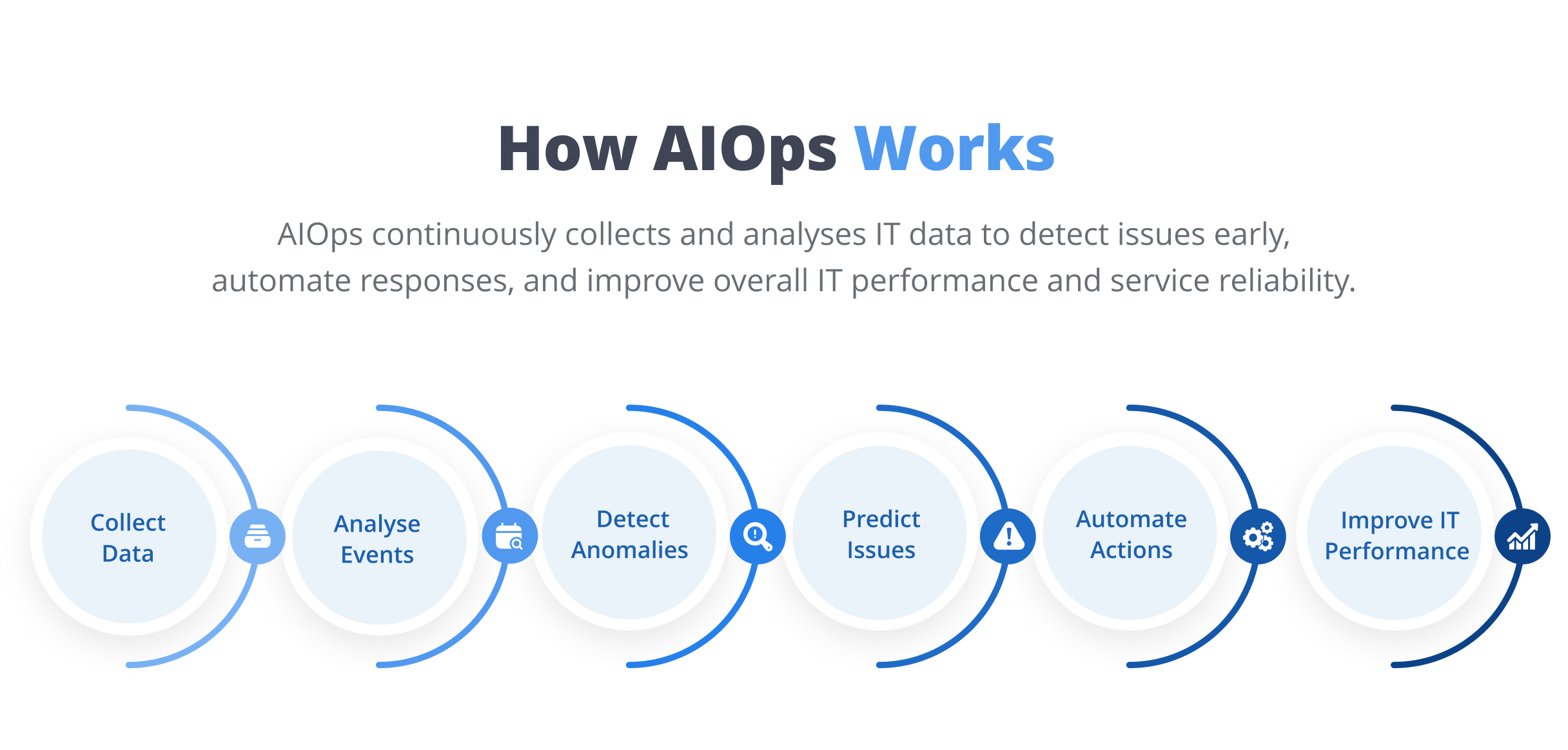
AIOps (Artificial Intelligence for IT Operations) is the use of artificial intelligence and machine learning to automate and enhance IT operations.
Instead of simply collecting monitoring data, AIOps analyses information from multiple sources, detects patterns, correlates events, predicts potential issues, and recommends or automates corrective actions.
An AIOps platform can monitor:
- Applications
- Servers
- Cloud infrastructure
- Networks
- Databases
- Security systems
- Business services
The result is faster problem detection, reduced downtime, and smarter IT decision-making.
Why traditional IT operations are no longer enough
As organisations adopt cloud platforms, hybrid environments, and digital services, IT operations become more complex.
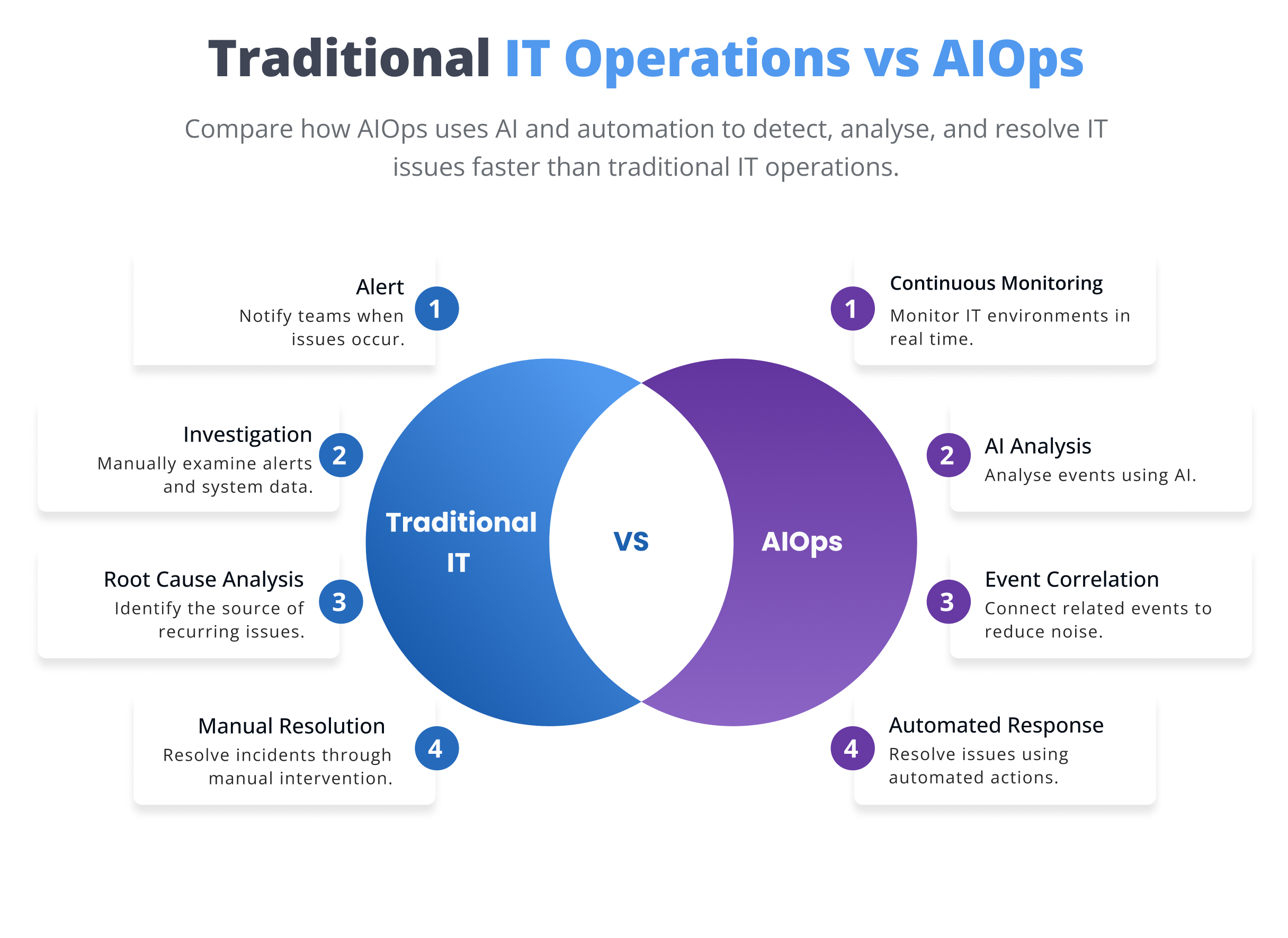
Traditional monitoring tools can generate alerts whenever something goes wrong, but they often require IT teams to manually investigate, identify the root cause, and resolve the issue, making it harder to keep pace with modern IT demands.
This approach creates several challenges:
- Too many alerts to investigate
- Slow incident resolution
- Limited visibility across systems
- Manual troubleshooting
- Repetitive operational tasks
- Difficulty identifying the root cause
- Increased operational pressure on IT teams
These challenges slow down business operations and affect user experiences, which makes stronger operational intelligence even more important.
Why AIOps is the missing link
Modern IT environments require more than monitoring; they require intelligence.
AIOps connects monitoring, analytics, automation, and decision-making into one intelligent operational framework, making it the missing link in modern IT operations.
Instead of reacting after incidents occur, AIOps helps organisations predict, prevent, and resolve issues before they become major business problems, strengthening day-to-day operations.
How AIOps transforms modern IT operations
AIOps changes the way IT teams monitor, investigate, and resolve issues across the enterprise.
Turns monitoring into intelligent monitoring
Traditional monitoring tools generate alerts whenever thresholds are crossed.
AIOps goes beyond alerting by analysing patterns across applications, infrastructure, and networks to determine which alerts truly matter and how they relate to each other.
This helps IT teams focus on critical incidents instead of being overwhelmed by alert noise.
Benefits
- Fewer false alerts
- Better prioritisation
- Faster incident detection
- Improved operational efficiency
Enables predictive IT operations
One of the biggest advantages of AIOps is its ability to identify potential problems before they affect business operations. By continuously analysing historical and real-time data, AIOps predicts possible infrastructure failures and performance issues. This allows organisations to take preventive action rather than waiting for disruptions to occur.
Benefits
- Reduced downtime
- Improved service availability
- Better capacity planning
- Lower operational risks
Accelerates root cause analysis
Finding the actual cause of an issue can often take longer than fixing the issue itself. AIOps automatically correlates logs, metrics, events, and application performance data to identify the most likely source of the problem and connect related signals. This significantly reduces investigation time.
Benefits
- Faster troubleshooting
- Reduced Mean Time to Resolution (MTTR)
- Better operational visibility
- Improved service reliability
Automates repetitive IT tasks
Many IT operations involve repetitive manual activities that consume valuable engineering time.
Examples include:
- Ticket creation
- Incident assignment
- Service restarts
- Health checks
- Alert notifications
- Standard remediation workflows
AIOps automates these routine tasks, allowing IT teams to focus on innovation and strategic initiatives.
Benefits
- Increased productivity
- Consistent operations
- Reduced manual effort
- Faster service restoration
Provides end-to-end visibility
Modern businesses operate across multiple environments, including on-premises infrastructure, cloud services, SaaS applications, and network devices. AIOps combines information from all these systems into one unified platform, linking disparate environments into a single operational view. This provides IT teams with complete visibility across their entire technology ecosystem.
Benefits
- Centralised monitoring
- Better collaboration
- Unified dashboards
- Faster decision-making
Key business benefits of AIOps
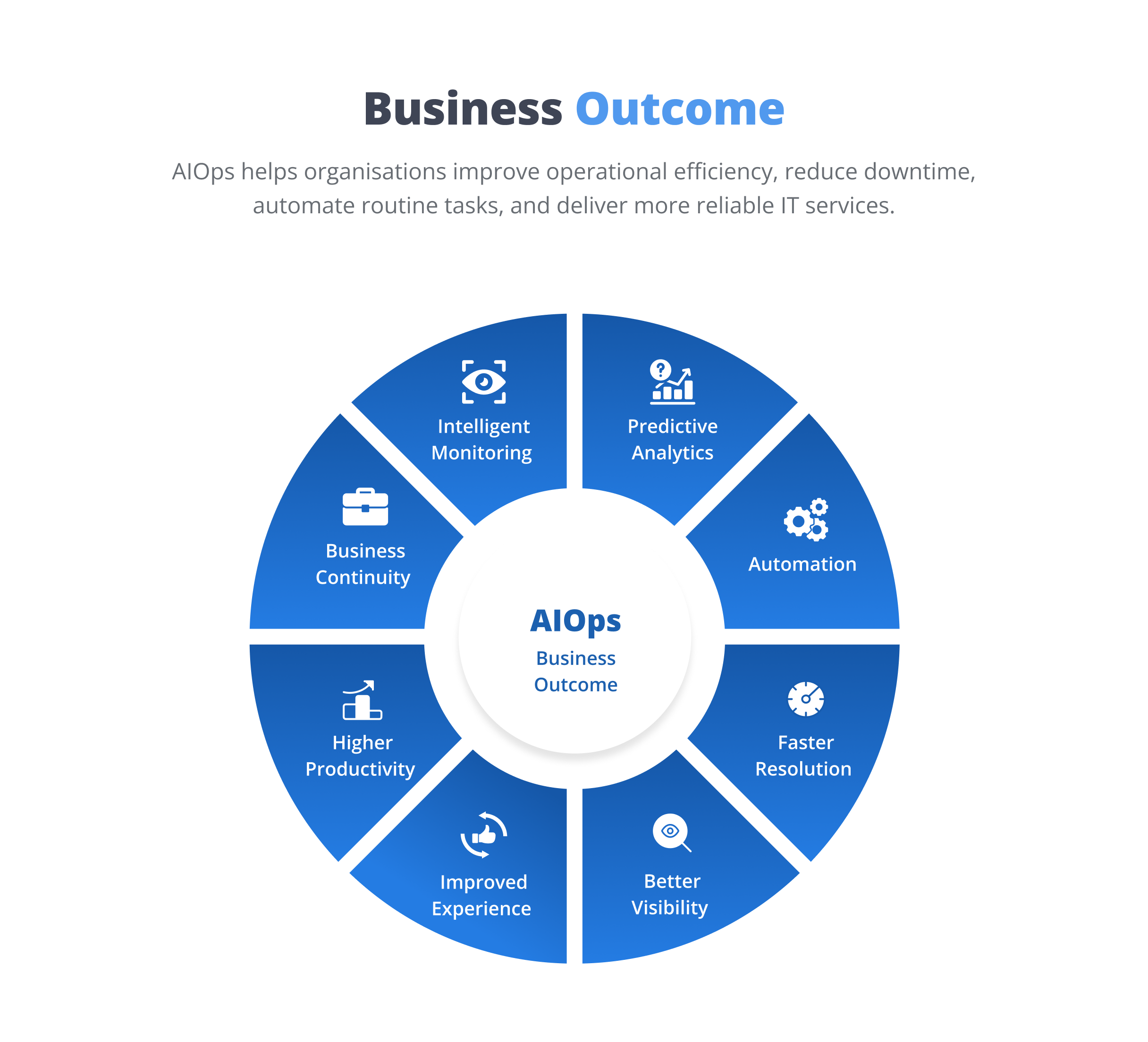
Implementing an AIOps platform offers several long-term advantages beyond IT monitoring.
These include:
- Improved operational efficiency
- Faster incident response
- Better customer experiences
- Reduced operational complexity
- Smarter decision-making
- Enhanced service reliability
- Greater IT team productivity
- Improved business continuity
Traditional IT operations vs AIOps
| Traditional IT Operations | AIOps |
|---|---|
| Reactive monitoring | Proactive monitoring |
| Manual investigation | AI-assisted analysis |
| Individual alerts | Intelligent event correlation |
| Manual workflows | Automated workflows |
| Separate monitoring tools | Unified operational visibility |
| Slow root cause analysis | AI-driven root cause analysis |
| Limited operational insights | Predictive analytics and recommendations |
How to prepare your organisation for AIOps
Adopting AIOps is not simply about deploying another monitoring tool. It requires organisations to modernise the way they manage IT operations.
Here are a few best practices:
- Consolidate monitoring across infrastructure
- Automate repetitive IT processes
- Standardise incident management
- Integrate monitoring and service management platforms
- Adopt predictive analytics
- Continuously review operational performance
- Encourage collaboration across IT teams
These practices help organisations maximise the value of AIOps while improving overall operational resilience.
Why choose iSense for intelligent IT operations?
As organisations embrace AIOps, they need more than just another monitoring solution. They need a platform that connects visibility, intelligence, and automation into a single operational experience.
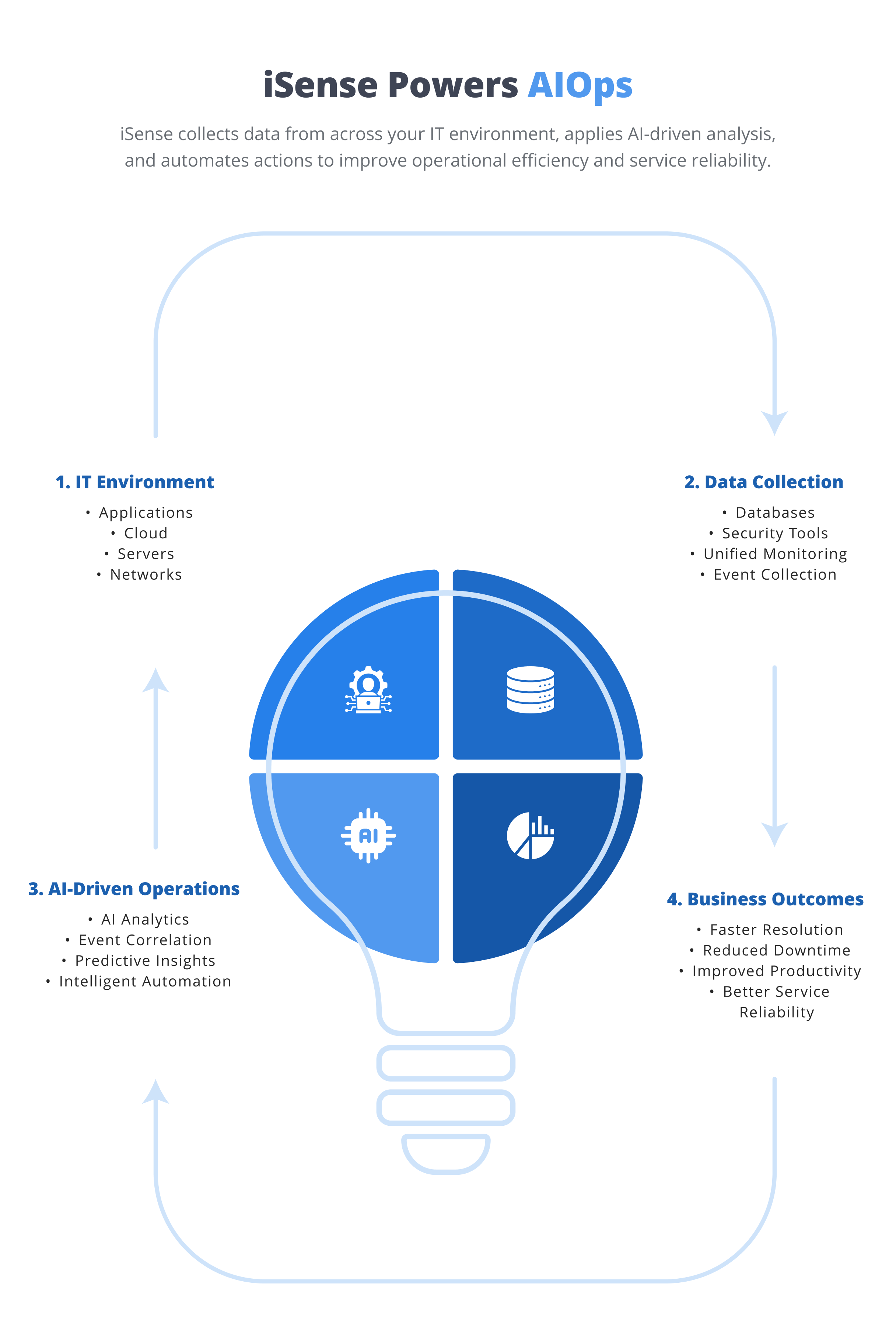
iSense by CATS4U is an intelligent AIOps platform designed to help businesses monitor, analyse, and optimise their IT environments with greater efficiency.
By combining intelligent event correlation, predictive analytics, automation, and real-time monitoring, iSense helps connect issues faster, reduce operational complexity, and improve service performance.
Key features of iSense:
- Intelligent event collection and correlation
- AI-powered predictive analytics
- Real-time infrastructure monitoring
- Automated incident response
- Interactive operational dashboards
- Root cause analysis support
- Multi-platform monitoring
- Centralised operational visibility
- Integration with enterprise IT tools
- Actionable performance insights
Whether you’re managing cloud infrastructure, enterprise applications, or hybrid environments, iSense helps transform traditional IT operations into intelligent, proactive, and resilient operations.
Modern IT operations have evolved far beyond traditional infrastructure monitoring. As businesses adopt cloud technologies, digital services, and increasingly complex IT environments, manual operations and isolated monitoring tools are no longer enough.
AIOps fills this gap by bringing together artificial intelligence, automation, predictive analytics, and intelligent monitoring into one unified approach, linking them to faster action and more reliable digital services.
For organisations looking to modernise their IT operations, adopting an AIOps platform is no longer just an advantage; it is becoming a necessity.
Solutions like iSense provide the intelligence and automation needed to simplify IT management, improve operational performance, and build a resilient, future-ready IT environment.
Frequently asked questions
AIOps uses artificial intelligence, machine learning, and automation to improve IT monitoring, incident management, and operational efficiency.
AIOps helps organisations manage complex IT environments by reducing alert fatigue, automating repetitive tasks, improving visibility, and predicting potential issues before they affect business operations.
Traditional monitoring primarily detects issues after they occur, while AIOps analyses data, predicts problems, correlates events, and automates responses to minimise disruptions.
Some key benefits include:
- Intelligent monitoring
- Predictive analytics
- Faster incident resolution
- Automated workflows
- Better operational visibility
- Improved service reliability
Yes. Modern AIOps platforms are designed to monitor and manage cloud, on-premises, hybrid, and multi-cloud environments from a single platform.
iSense combines intelligent monitoring, AI-powered analytics, event correlation, automation, and operational dashboards to help organisations optimise IT operations, reduce downtime, and improve service performance.
