


Modern IT environments have become increasingly complex. Organisations now manage hybrid infrastructure, cloud applications, multiple monitoring tools, remote workforces, and thousands of connected devices. As businesses continue to grow, managing IT operations manually becomes more challenging.
Traditional monitoring tools can detect issues, but they often overwhelm IT teams with alerts and require manual investigation. This delays problem resolution and impacts business continuity.
This is where Artificial Intelligence for IT Operations (AIOps) transforms the way businesses manage their IT infrastructure. By combining artificial intelligence, machine learning, automation, and analytics, AIOps helps organisations identify issues faster, reduce downtime, and improve operational efficiency.
As technology continues to evolve, AIOps is becoming central to modern IT strategies. In this guide, we’ll explore the top five AIOps trends shaping IT operations in 2026 and explain what they mean for businesses preparing for the future.
What is AIOps?
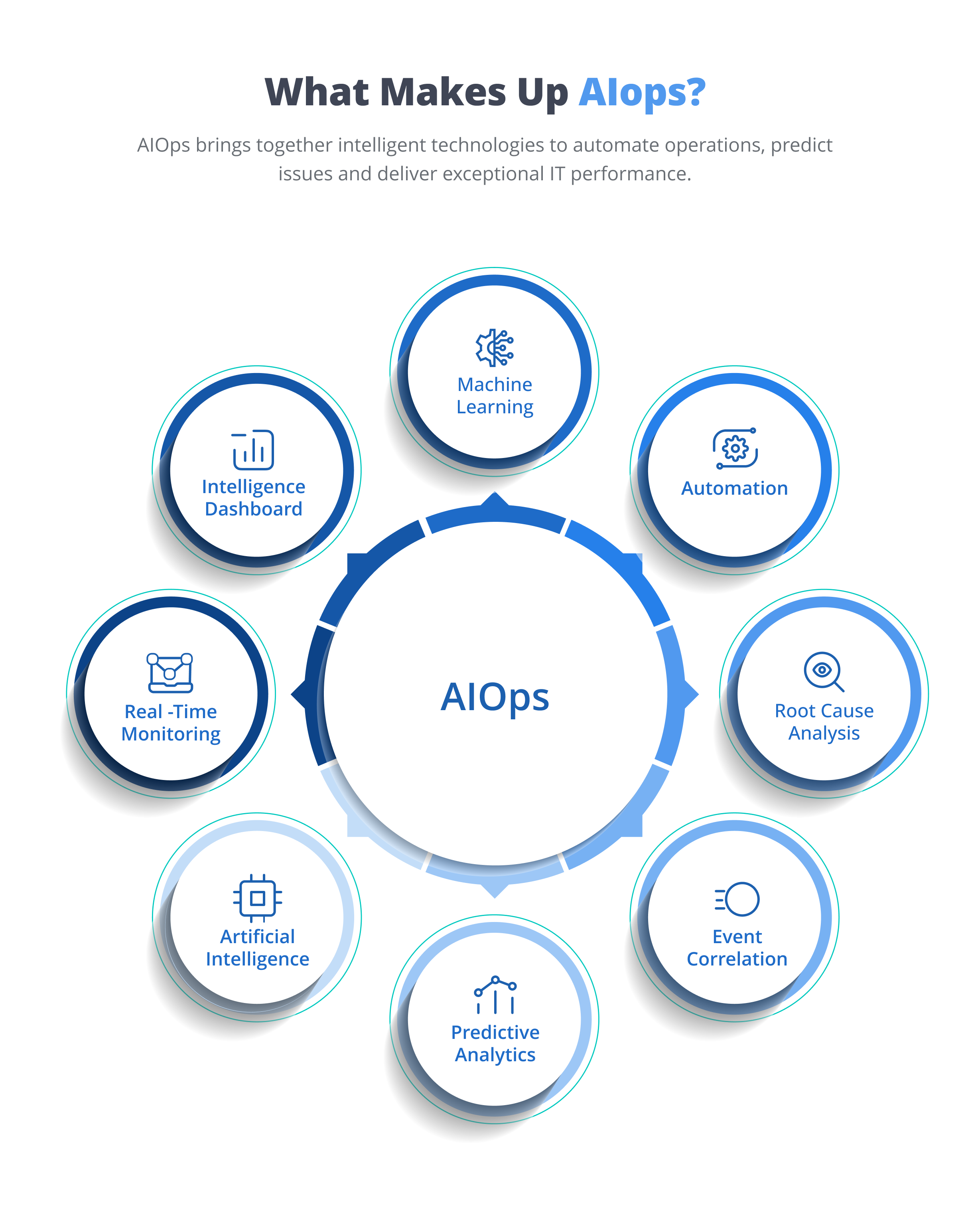
AIOps (Artificial Intelligence for IT Operations) is the practice of using artificial intelligence and machine learning to automate and improve IT operations.
Instead of relying solely on manual monitoring, AIOps continuously collects and analyses data from multiple IT systems. This helps organisations detect anomalies, predict potential failures, and automate routine tasks.
An AIOps platform can monitor:
- Servers
- Applications
- Networks
- Cloud infrastructure
- Databases
- Security events
- Business applications
By analysing data in real time, AIOps helps IT teams respond to issues before they impact users.
Why is AIOps becoming more important?
As IT environments become larger and more connected, businesses face challenges such as:
- Large volumes of monitoring alerts
- Complex hybrid cloud environments
- Increasing operational costs
- Longer incident resolution times
- Difficulty identifying root causes
- Limited visibility across infrastructure
AIOps addresses these challenges by making IT operations smarter, faster, and more proactive, helping organisations manage complexity with greater control.
Top 5 AIOps trends shaping IT operations in 2026
Let’s explore the trends that are redefining modern IT operations and shaping how businesses prepare for what comes next.
Predictive IT operations will replace reactive monitoring
Traditional monitoring tells IT teams when something has already gone wrong.
Modern AIOps platforms go a step further by identifying patterns that indicate a potential issue before it affects business operations, helping teams act sooner.
Instead of waiting for server failures or application outages, AIOps continuously analyses system behaviour and predicts possible risks.
Benefits
- Early issue detection
- Reduced downtime
- Better infrastructure planning
- Improved service availability
Reactive vs Predictive IT Operations
| Reactive Monitoring | Predictive Operations |
|---|---|
| Detects failures | Predicts failures |
| Manual investigation | AI-driven analysis |
| Respond after outages | Prevent outages |
| Longer resolution time | Faster resolution |
Intelligent event correlation will reduce alert fatigue
Modern organisations generate thousands of alerts every day.
Many of these alerts are duplicates or symptoms of the same underlying issue.
Instead of forcing IT teams to investigate every alert individually, AIOps platforms intelligently correlate related events into a single incident, making it easier to focus on the real issue.
This helps engineers focus on resolving the actual problem instead of managing alert noise.
Benefits
- Fewer unnecessary alerts
- Faster root cause identification
- Improved productivity
- Better incident management
AI-powered root cause analysis will become the standard
Finding the root cause of an incident often takes longer than resolving the issue itself.
AIOps platforms analyse logs, infrastructure metrics, application performance, and historical incidents simultaneously.
By connecting these data sources, AI helps identify the most likely cause of a problem within minutes, helping teams resolve incidents more quickly.
This significantly reduces troubleshooting time and improves service reliability.
Benefits
- Faster investigations
- Reduced Mean Time to Resolution (MTTR)
- Better operational visibility
- Improved customer experience
Intelligent automation will handle routine IT tasks
IT teams spend a significant amount of time performing repetitive operational tasks.
Examples include:
- Restarting services
- Clearing temporary storage
- Assigning incidents
- Running health checks
- Creating support tickets
- Executing standard remediation workflows
AIOps platforms increasingly automate these routine activities, allowing engineers to focus on more strategic initiatives and improve operational efficiency.
Automation also reduces manual errors and improves operational consistency.
Benefits
- Increased productivity
- Reduced manual effort
- Faster issue resolution
- Consistent operational processes
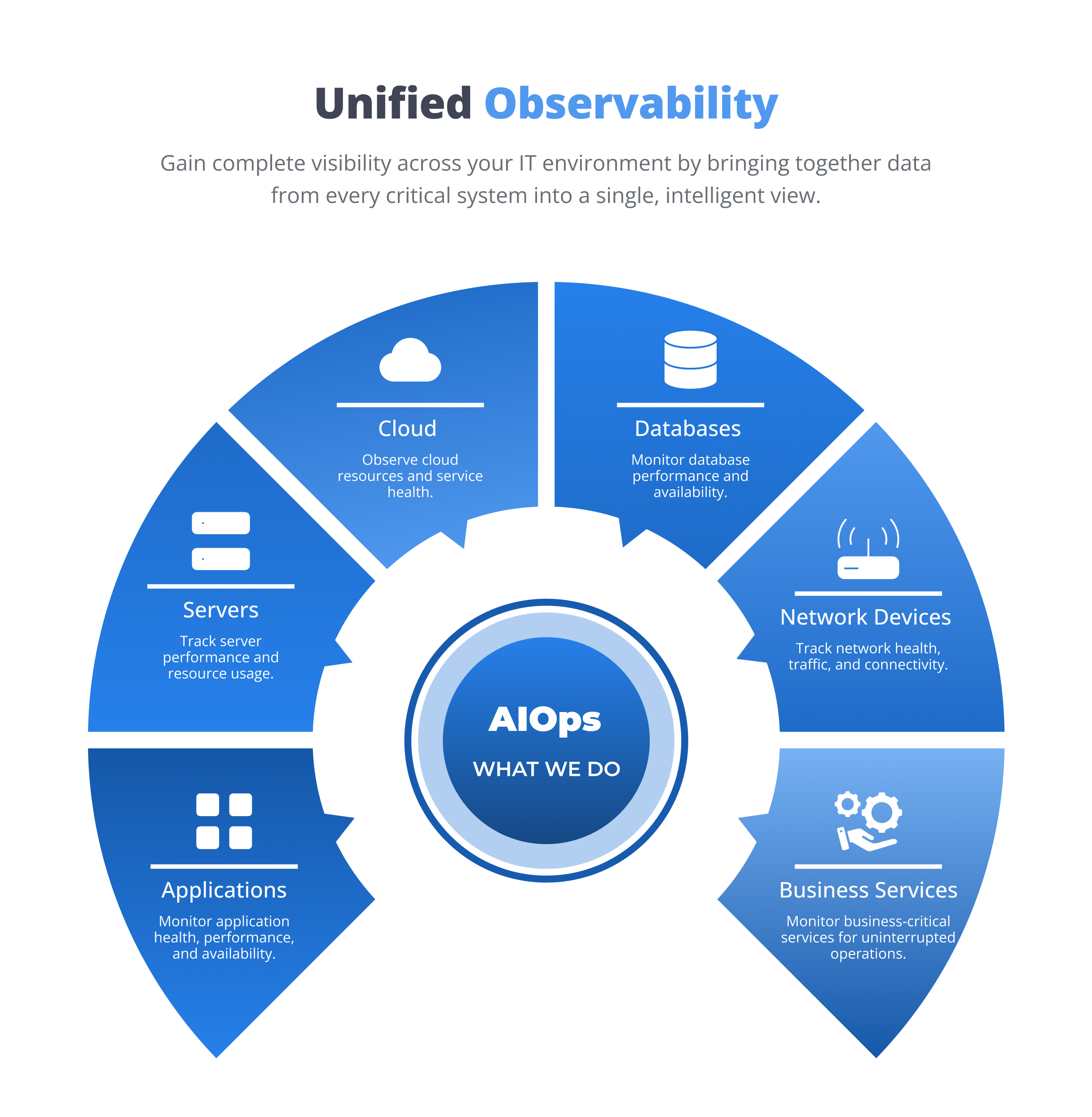
Unified observability will improve end-to-end visibility
Today’s IT infrastructure spans cloud platforms, on-premises systems, applications, databases, networks, and security tools
Managing each system separately creates information silos.
Modern AIOps platforms combine data from multiple monitoring tools into a single dashboard, giving IT teams complete visibility across the entire technology landscape and improving decision-making.
This unified approach enables faster decision-making and better service management.
Benefits
- Complete infrastructure visibility
- Centralised monitoring
- Better performance insights
- Improved collaboration across IT teams
Traditional IT operations vs AIOps
| Traditional IT Operations | AIOps |
|---|---|
| Manual monitoring | Intelligent monitoring |
| Individual alerts | Event correlation |
| Reactive issue resolution | Predictive issue prevention |
| Manual troubleshooting | AI-assisted root cause analysis |
| Separate monitoring tools | Unified observability |
| Manual workflows | Intelligent automation |
How businesses can prepare for these AIOps trends
Adopting AIOps is not just about implementing AI; it requires building a modern operational strategy that better connects tools, data, and workflows.
Organisations should focus on:
- Centralising monitoring data
- Automating repetitive workflows
- Improving infrastructure visibility
- Standardising incident management
- Integrating IT monitoring tools
- Leveraging predictive analytics
- Continuously analysing operational performance
Taking these steps helps businesses move from reactive IT management to proactive and intelligent operations.
Why choose iSense for intelligent IT operations?
As AIOps continues to transform IT operations, businesses need a platform that not only monitors infrastructure but also turns that visibility into actionable intelligence.
iSense by CATS4U is an intelligent AIOps platform designed to help organisations simplify IT operations through real-time monitoring, event correlation, predictive analytics, and automation.
Instead of managing multiple disconnected monitoring tools, iSense brings everything together into a single intelligent platform, helping IT teams detect issues faster, reduce alert fatigue, and improve overall service reliability.
Key features of iSense:
- Intelligent event collection and correlation
- Predictive analytics for proactive issue detection
- Real-time infrastructure monitoring
- Automated incident response workflows
- Interactive dashboards and visualisation
- Root cause analysis support
- Multi-platform monitoring
- Centralised operational visibility
- Integration with existing IT tools
- Actionable performance insights
Whether your organisation is managing cloud infrastructure, enterprise applications, or hybrid environments, iSense helps transform traditional IT operations into a smarter, AI-driven ecosystem that supports better outcomes.
Conclusion
The future of IT operations is becoming increasingly intelligent, automated, and proactive. As organisations continue to adopt hybrid infrastructure, cloud technologies, and digital services, manually managing complex IT environments is no longer sustainable.
The top AIOps trends shaping 2026, from predictive operations and intelligent event correlation to AI-powered root cause analysis, automation, and unified observability, are helping businesses improve efficiency, minimise disruptions, and deliver more reliable IT services.
By embracing these trends, organisations can move beyond reactive IT management and build resilient, future-ready operations that support long-term performance.
Solutions like iSense make this transition easier by combining intelligent monitoring, automation, predictive analytics, and actionable insights into a single platform, helping IT teams work smarter and respond faster.
Frequently asked questions
AIOps uses artificial intelligence, machine learning, and automation to improve IT operations by monitoring systems, analysing data, detecting issues, and automating responses.
AIOps helps organisations manage increasingly complex IT environments by reducing manual effort, improving visibility, predicting potential issues, and accelerating incident resolution.
Some of the key AIOps trends include:
- Predictive IT operations
- Intelligent event correlation
- AI-powered root cause analysis
- Workflow automation
- Unified observability
AIOps continuously monitors IT environments, identifies abnormal behaviour, predicts potential failures, and automates responses before issues impact business operations.
Unified observability brings data from applications, infrastructure, cloud services, networks, and databases into a single platform, providing complete visibility across the IT environment.
iSense combines intelligent monitoring, event correlation, predictive analytics, automation, and operational dashboards to help organisations improve IT performance, reduce alert fatigue, and deliver reliable digital services.
