


Enterprise networks have evolved dramatically over the past decade. Businesses now operate across branch offices, cloud environments, data centres, hybrid infrastructures, and remote workforces, all of which rely on seamless and secure network connectivity.
While networks have become more dynamic, many organisations still manage them using traditional methods that rely heavily on manual configurations, isolated tools, and reactive troubleshooting.
Although these approaches worked when networks were smaller and less complex, they struggle to keep pace with today’s enterprise demands.
Modern organisations need faster deployments, greater visibility, stronger security, and the ability to manage increasingly complex environments without increasing operational overhead.
In this blog, we’ll explore why traditional network management is no longer enough, the challenges organisations face, and how modern network provisioning platforms like iProvision help simplify enterprise network operations.
What is traditional network management?
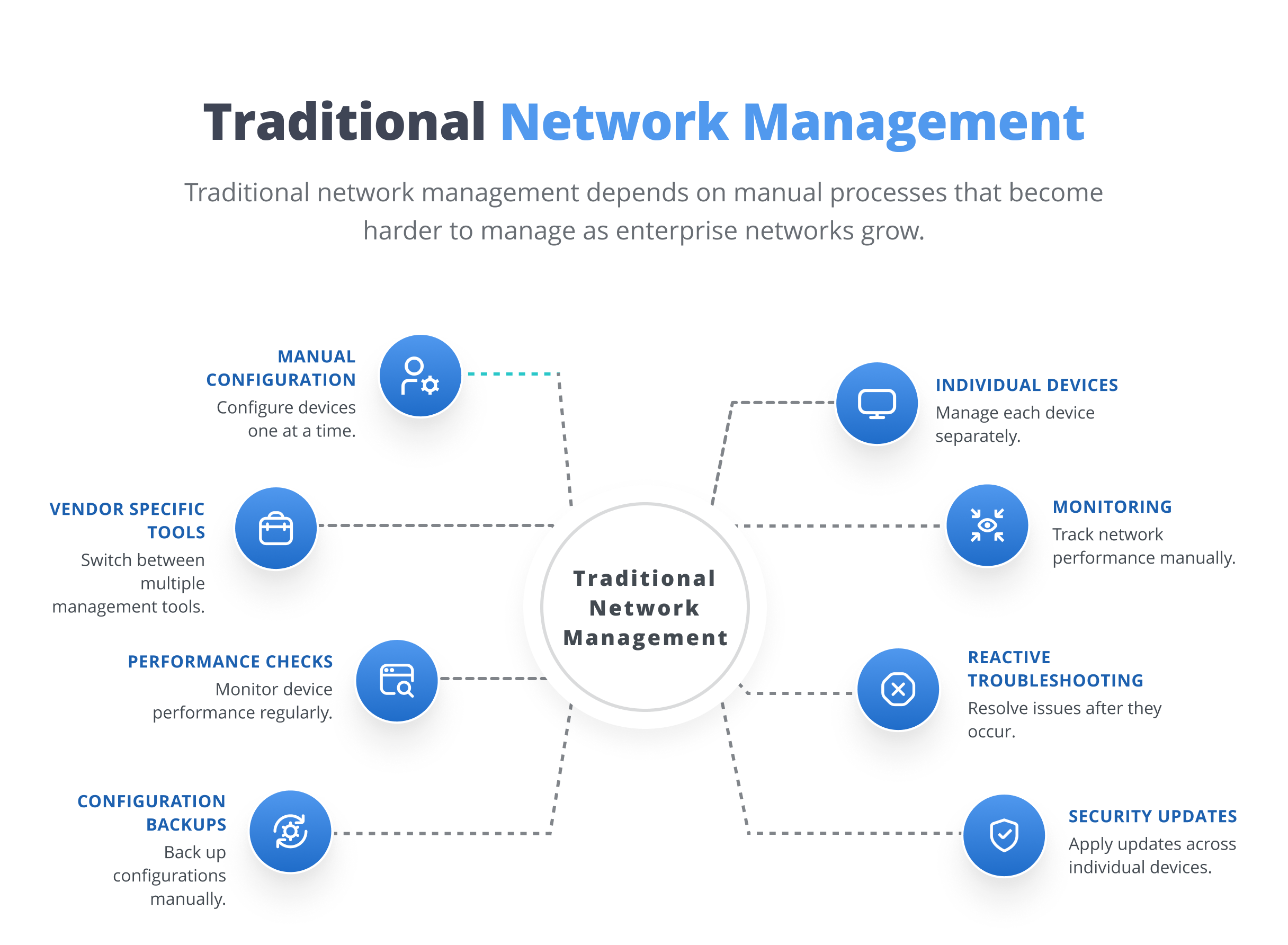
Traditional network management refers to the manual processes used to configure, monitor, maintain, and troubleshoot network devices and infrastructure.
Network administrators typically manage routers, switches, firewalls, and other devices individually using command-line interfaces (CLI) or separate vendor-specific management tools.
Common activities include:
- Manual device configuration
- Individual firmware updates
- Network monitoring
- Device troubleshooting
- Configuration backups
- Security policy updates
- Performance monitoring
While these methods have been used successfully for years, they become increasingly difficult to manage as enterprise networks grow.
Why traditional network management falls short
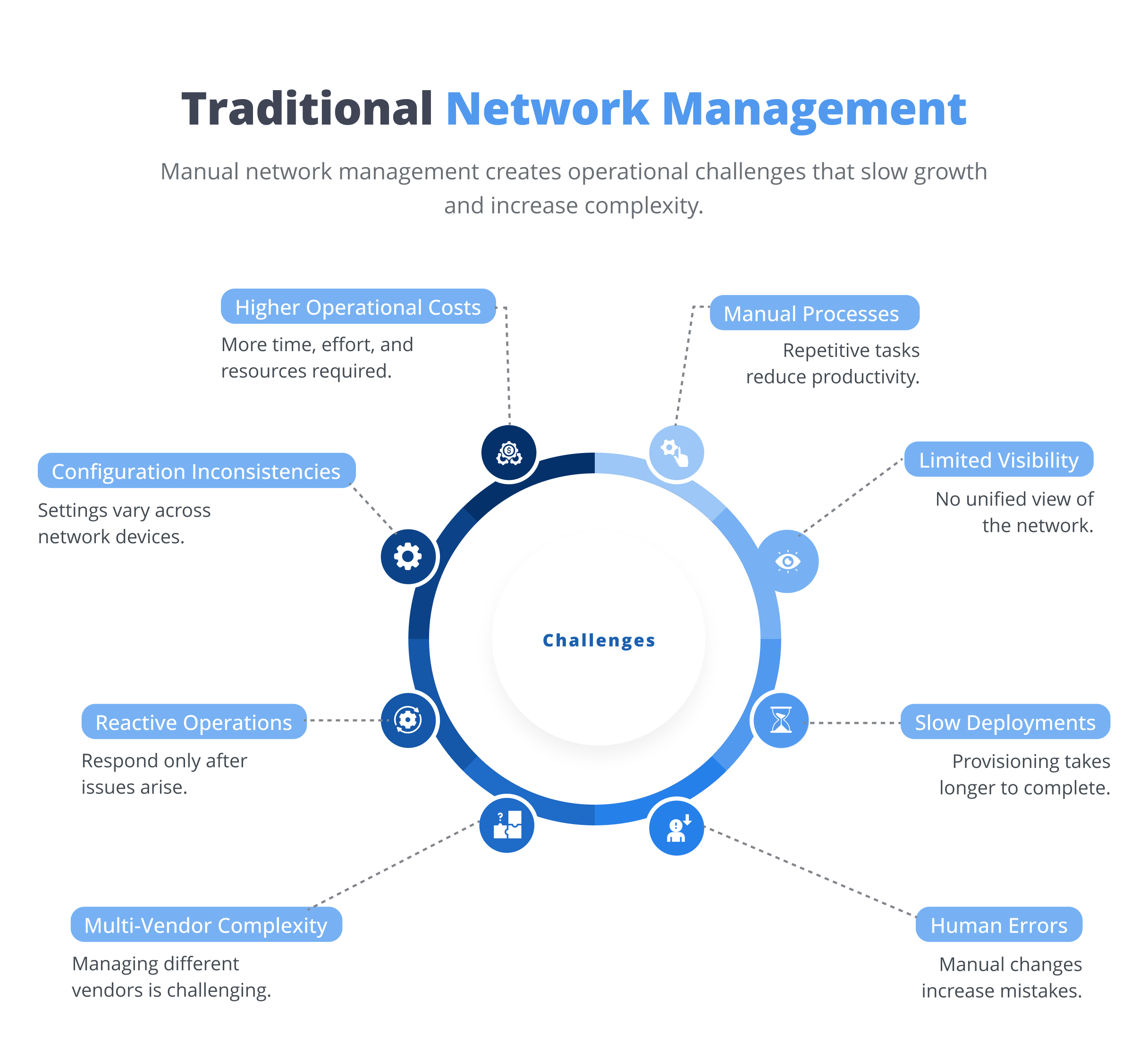
As enterprise environments become more distributed and technology continues to evolve, manual network management introduces several operational challenges.
Increasing network complexity
Managing these environments manually becomes increasingly difficult.
Modern enterprises operate across:
- Multiple branch offices
- Cloud platforms
- Data centres
- Hybrid environments
- Remote users
- IoT devices
Time-consuming configuration
Provisioning new devices often requires engineers to configure every device individually.
This results in
- Longer deployment times
- Repetitive administrative tasks
- Increased workload
Higher risk of human error
Manual configurations increase the likelihood of errors. Even small mistakes can impact multiple business services.
Common risks
- Incorrect settings
- Policy inconsistencies
- Configuration drift
- Service disruptions
Limited network visibility
Traditional tools often provide isolated views of individual devices instead of offering complete visibility across the network.
Without centralised monitoring, IT teams may struggle to
- Identify issues quickly
- Track configuration changes
- Understand network dependencies
- Monitor overall network health
Reactive instead of proactive operations
Many traditional environments only respond after issues occur. Modern enterprises require proactive monitoring and intelligent automation.
This leads to
- Longer troubleshooting times
- Increased downtime
- Delayed service restoration
What modern enterprises need instead
Today’s enterprise networks require solutions that simplify operations while supporting business growth.
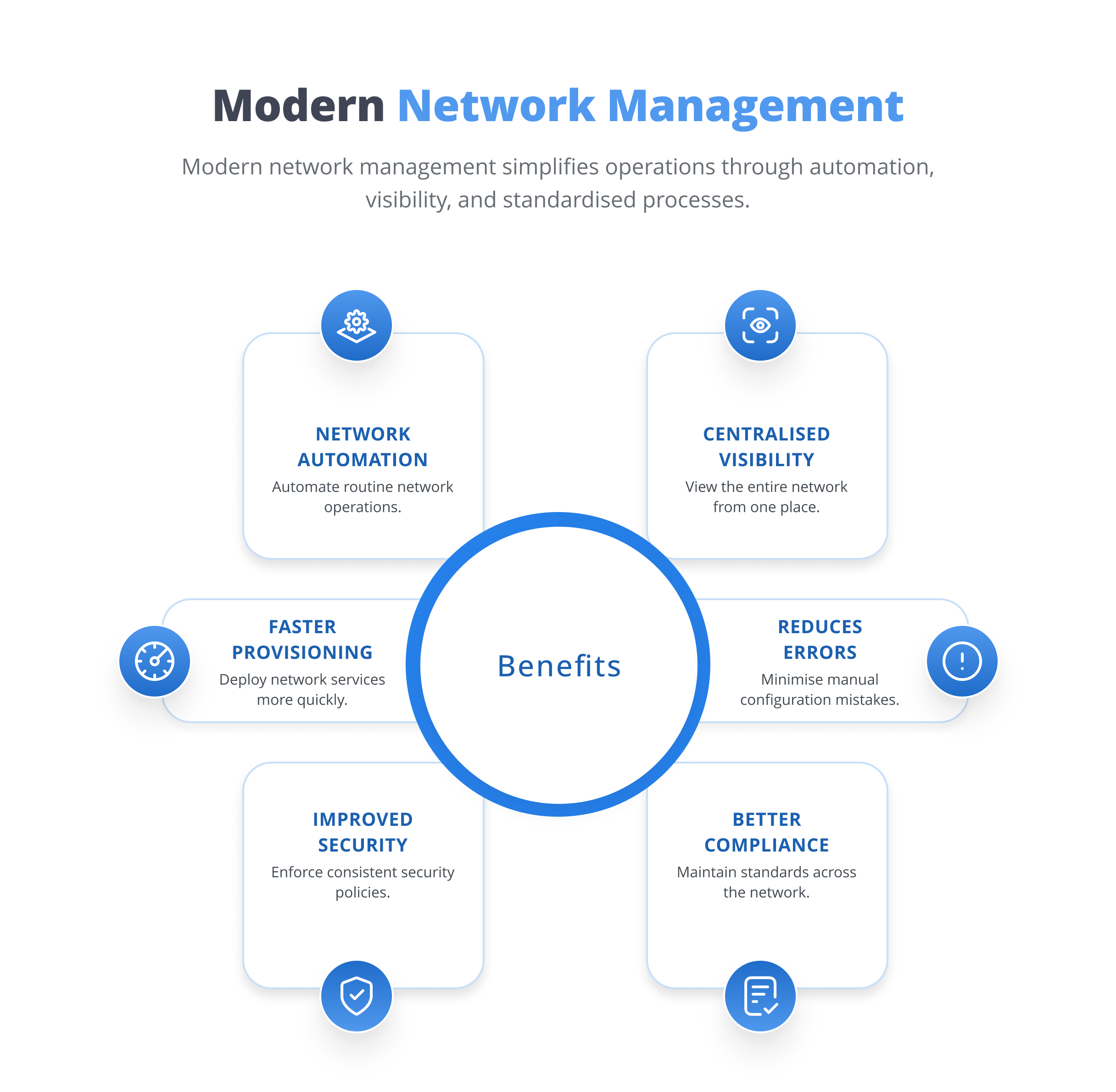
Modern network management platforms provide:
- Automated network provisioning
- Centralised device management
- Multi-vendor support
- Policy-based configuration
- Real-time network visibility
- Configuration validation
- Workflow automation
- Performance monitoring
Rather than replacing network teams, these capabilities help them focus on strategic initiatives instead of repetitive manual tasks.
Traditional network management vs modern network management
| Traditional Network Management | Modern Network Management |
|---|---|
| Manual device configuration | Automated network provisioning |
| Separate vendor tools | Unified management platform |
| Reactive troubleshooting | Proactive monitoring |
| Device-level visibility | End-to-end network visibility |
| Manual configuration validation | Automated policy validation |
| Slow deployments | Faster network rollouts |
| Difficult to scale | Easily supports enterprise growth |
| High administrative effort | Intelligent workflow automation |
Benefits of modern network management
Adopting a modern approach to network management offers advantages across operations, IT teams, and the business.
Best practices for modern network management
Organisations looking to modernise their network operations should consider the following best practices:
- Standardise network configuration templates
- Automate repetitive provisioning tasks
- Maintain a central inventory of network devices
- Continuously monitor network health
- Validate configurations before deployment
- Implement policy-based network management
- Integrate provisioning with monitoring and operational workflows
These practices help improve consistency, reduce operational complexity, and support scalable network growth.
Why choose iProvision for modern network management?
Managing today’s enterprise networks requires more than monitoring devices. Organisations need an intelligent platform that automates provisioning, simplifies configuration management, and provides complete visibility across their network infrastructure.
iProvision by CATS4U is an enterprise network provisioning and operations platform designed to help organisations modernise network management.
It enables IT teams to automate configuration, manage multi-vendor environments, monitor network performance, and streamline provisioning workflows through a single, unified platform.
Key features of iProvision:
- Automated network provisioning
- Configuration template management
- Multi-vendor device support
- SDN provisioning
- Configuration validation
- Network inventory management
- Centralised monitoring
- Workflow automation
- Policy-driven configuration management
- Native integration across the CATS4U suite
Whether you’re managing branch offices, cloud networks, or large enterprise infrastructures, iProvision helps simplify network operations while improving efficiency, consistency, and reliability.
Conclusion
Traditional network management has served organisations well for many years, but today’s enterprise networks demand a more agile, automated, and scalable approach.
As networks become larger and more distributed, relying on manual configurations and disconnected management tools can slow operations, increase errors, and limit visibility.
Modern network management solutions help organisations simplify complexity through automation, centralised visibility, and standardised processes.
With iProvision, enterprises can move beyond traditional network management by automating provisioning, streamlining operations, and gaining complete visibility across their network infrastructure, enabling IT teams to deliver faster, more reliable, and future-ready network services.
Frequently asked questions
Traditional network management relies on manual processes and isolated tools, making it difficult to manage modern, distributed, and multi-vendor enterprise networks efficiently.
Common challenges include:
- Manual configurations
- Limited visibility
- Human errors
- Slow deployments
- Reactive troubleshooting
- Difficult scalability
- Multi-vendor complexity
Modern network management uses automation, centralised monitoring, policy-based configuration, and intelligent provisioning to simplify enterprise network operations.
Some key benefits include:
- Faster deployments
- Improved visibility
- Reduced manual effort
- Better network reliability
- Enhanced operational efficiency
- Simplified compliance
Yes. Modern network management platforms provide centralised management across devices from multiple vendors, reducing operational complexity.
iProvision automates network provisioning, configuration management, policy validation, monitoring, and workflow automation, helping organisations simplify operations and gain complete visibility across SDN and multi-vendor enterprise networks.
