


Every organisation depends on hundreds of business processes to keep operations running smoothly. From employee onboarding and customer service to procurement, finance, and approvals, these processes involve multiple people, systems, and applications working together.
However, many organisations still rely on disconnected workflows, manual approvals, spreadsheets, emails, and siloed applications. As businesses grow, these fragmented processes become difficult to manage, leading to delays, errors, and poor visibility
This is where process orchestration becomes essential.
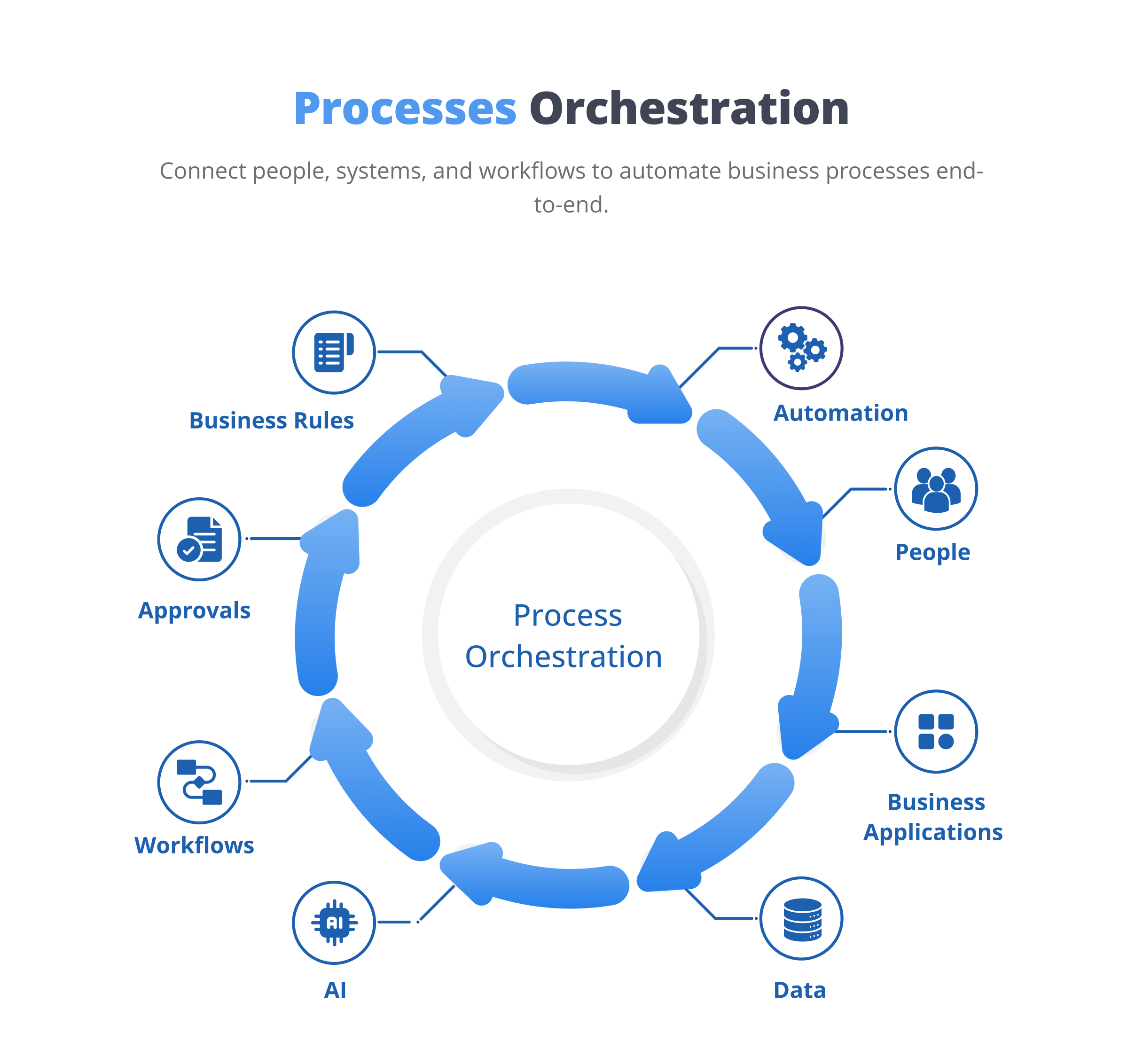
Process orchestration connects people, systems, data, and workflows into one coordinated process. Instead of managing tasks separately, organisations can automate and orchestrate end-to-end business operations through a single intelligent platform.
In this blog, we’ll explore what process orchestration is, why it matters, its key benefits, and how iProcess helps organisations build intelligent, automated workflows with ease.
What is process orchestration?
Process orchestration is the practice of coordinating multiple business activities, systems, applications, and users into a single, streamlined workflow.
Unlike simple workflow automation, process orchestration manages the entire business process from start to finish, ensuring that every task happens in the right sequence, with the right data, and at the right time.
A process orchestration platform can:
- Connect multiple business applications
- Automate approvals and workflows
- Coordinate human and system tasks
- Trigger actions across departments
- Integrate with enterprise systems
- Manage business rules
- Provide real-time process visibility
- Improve collaboration across teams
The result is a more connected, efficient, and scalable way to manage business operations.
Why does process orchestration matter?
Business processes rarely happen within a single department or application.
For example, processing a customer order may involve:
- Sales
- Finance
- Inventory
- Logistics
- Customer support
- ERP
- CRM
- Payment systems
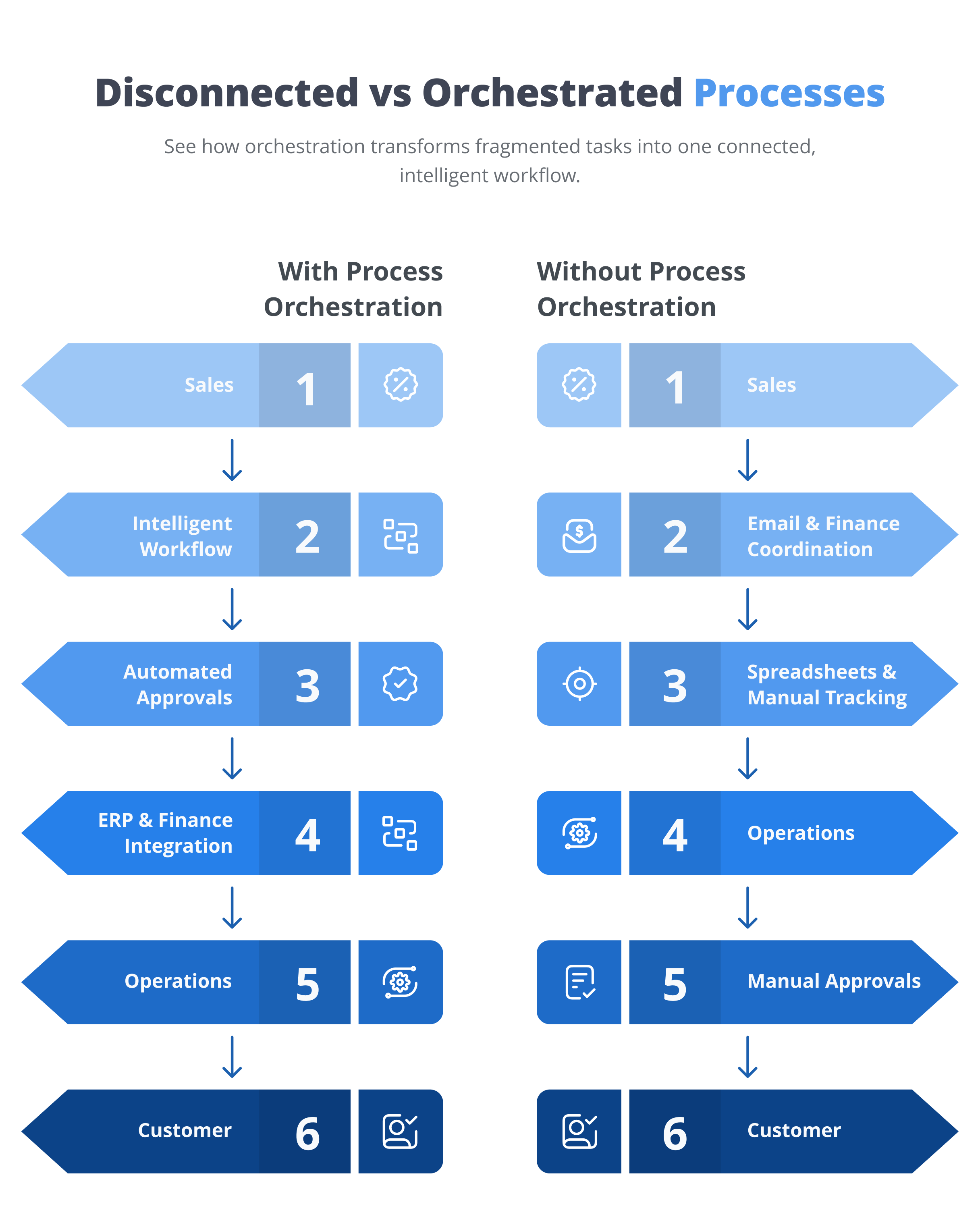
Without orchestration, these teams often work independently, relying on manual communication and disconnected systems.
This can result in:
- Delayed approvals
- Duplicate work
- Data inconsistencies
- Limited visibility
- Manual errors
- Slow decision-making
- Poor customer experience
Process orchestration eliminates these challenges by connecting every stage of the workflow into one seamless process.
How does process orchestration work?
A process orchestration platform brings together workflows, systems, and business rules into one automated process.
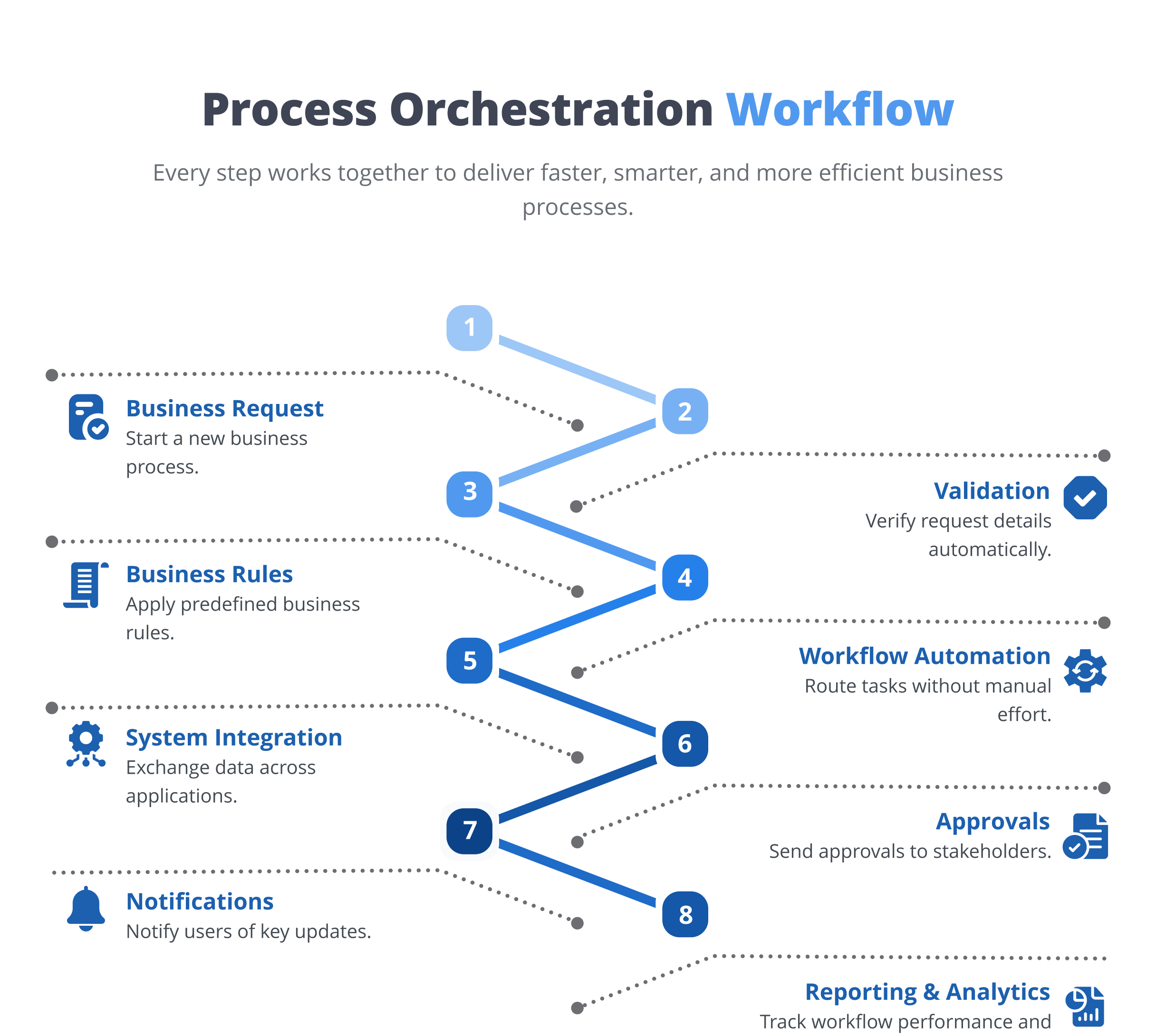
A typical workflow looks like this:
- A business request is initiated
- The platform validates the request
- Business rules determine the next action
- Tasks are automatically assigned
- Systems exchange data automatically
- Approvals are routed to the right stakeholders
- Notifications are triggered
- The workflow is completed with full visibility and reporting
Every stage is connected, reducing delays and ensuring consistent execution.
Process orchestration vs workflow automation
Although these terms are often used interchangeably, they serve different purposes.
| Workflow Automation | Process Orchestration |
|---|---|
| Automates individual tasks | Coordinates complete business processes |
| Focuses on a single workflow | Connects multiple workflows and systems |
| Limited visibility | End-to-end process visibility |
| Department-specific | Enterprise-wide automation |
| Basic task execution | Intelligent process coordination |
| Minimal system integration | Deep integration across applications |
| Suitable for simple workflows | Ideal for complex enterprise processes |
Process orchestration goes beyond automation by ensuring every workflow works together as part of a larger business process.
Key benefits of process orchestration
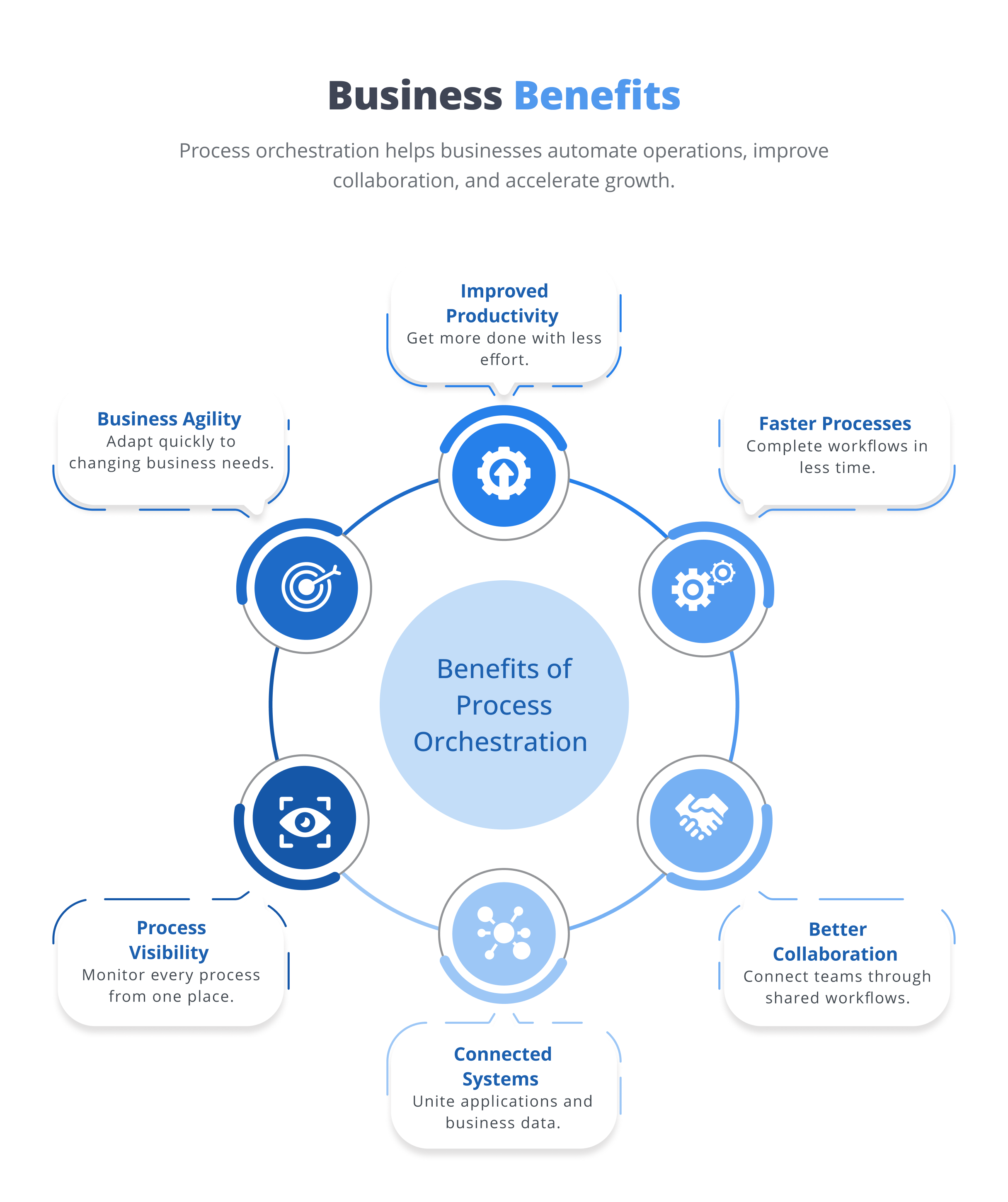
Modern organisations adopt process orchestration to improve efficiency, agility, and collaboration across the enterprise.
Eliminate manual processes
Reduce repetitive work by automating routine business activities.
Benefits
- Faster execution
- Fewer manual errors
- Increased productivity
Connect disconnected systems
Integrate ERP, CRM, HRMS, finance, and third-party applications into one workflow.
Benefits
- Unified operations
- Better data consistency
- Improved collaboration
Accelerate business processes
Automate approvals, notifications, and task routing.
Benefits
- Faster turnaround times
- Improved operational efficiency
- Better customer experience
Improve process visibility
Track every workflow, approval, and process stage from a central dashboard.
Benefits
- Real-time visibility
- Easier monitoring
- Better decision-making
Support business growth
Scale workflows without increasing operational complexity.
Benefits
- Greater flexibility
- Standardised operations
- Easier expansion
Enable intelligent automation
Combine business rules, AI, and automation to make processes smarter.
Benefits
- Improved efficiency
- Better resource utilisation
- Consistent execution
Common use cases for process orchestration
Process orchestration can transform workflows across almost every business function.
Why choose iProcess for enterprise process orchestration?
Managing modern business processes requires more than simple workflow automation. Organisations need a platform that connects people, systems, data, and AI into intelligent, end-to-end workflows.
iProcess by CATS4U is a low-code enterprise process orchestration and automation platform designed to help businesses build, automate, and manage complex workflows without extensive coding.
With iProcess, organisations can rapidly design intelligent workflows, automate approvals, integrate enterprise applications, and gain complete visibility into business operations through one unified platform.
Key features of iProcess:
- Low-code workflow designer
- Intelligent process orchestration
- Business rules engine
- AI-powered automation
- Workflow approvals
- Enterprise system integrations
- Process dashboards and analytics
- Role-based access controls
- Document and task management
- Native integration across the CATS4U suite
Whether you’re automating HR processes, finance approvals, customer onboarding, or enterprise operations, iProcess enables organisations to build scalable, intelligent workflows that improve efficiency and accelerate digital transformation.
Conclusion
As businesses continue to embrace digital transformation, disconnected workflows and manual processes are no longer enough to support growing operational demands.
Process orchestration provides a smarter way to manage business operations by connecting people, systems, and data into intelligent, automated workflows. It improves efficiency, enhances visibility, and ensures that every process runs consistently from start to finish.
For organisations looking to modernise operations and simplify complex workflows, process orchestration is no longer just an operational improvement; it’s a strategic capability.
With iProcess, businesses can orchestrate enterprise-wide workflows, automate routine tasks, and build intelligent, scalable processes that drive productivity and business growth.
Frequently asked questions
Process orchestration is the coordination of people, systems, applications, and workflows to automate and manage complete business processes from start to finish.
Workflow automation focuses on automating individual tasks, while process orchestration connects multiple workflows, systems, and business rules to manage an entire business process.
Some key benefits include:
- Faster business processes
- Reduced manual effort
- Better collaboration
- End-to-end visibility
- Improved productivity
- Intelligent automation
- Easier scalability
Process orchestration can be applied to HR, finance, IT, procurement, customer service, operations, compliance, and many other enterprise workflows.
Yes. Modern process orchestration platforms integrate with ERP, CRM, HRMS, finance applications, databases, cloud services, and third-party business systems.
iProcess enables organisations to design, automate, and orchestrate intelligent workflows using a low-code platform that connects people, systems, data, and AI while providing complete visibility into enterprise operations.
