


Businesses today rely on technology more than ever before. From communicating with customers to managing employees and delivering services, almost every business function depends on digital tools. However, using technology alone is not digital transformation; it is the starting point.
True digital transformation is about changing the way an organisation operates by integrating technology into everyday processes. It helps businesses become more efficient, improve customer experiences, and respond quickly to changing market demands. This is why a structured approach to managing technology is essential.
While adopting new technologies is important, managing them effectively is equally critical. Without proper IT processes, organisations may face system downtime, delayed support, poor user experiences, and security risks.
This is where IT Service Management (ITSM) plays a vital role. ITSM provides a structured approach to managing IT services, ensuring that technology directly supports business goals instead of becoming a challenge. In digital transformation, ITSM helps make technology usable, reliable, and aligned with business needs.
In this blog, we’ll explore digital transformation, why it matters, and how ITSM can help organisations achieve it successfully.
What is digital transformation?
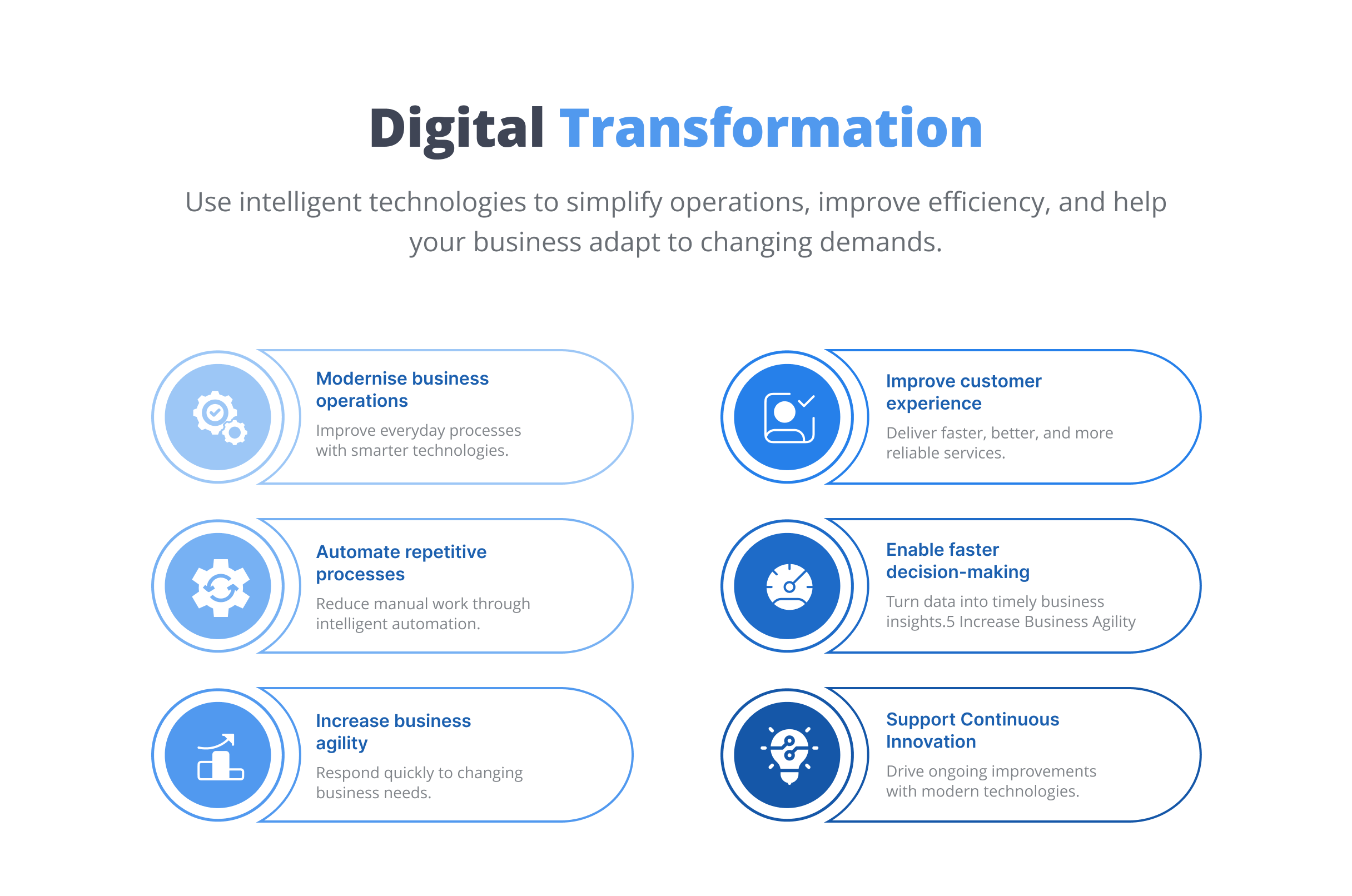
Digital transformation is the process of using digital technologies to improve business operations, customer experiences, and overall organisational performance. It is not just about replacing manual work with software; it also involves rethinking business processes, improving collaboration, and creating more efficient ways of working.
Digital transformation allows businesses to:
- Improve operational efficiency
- Deliver better customer experiences
- Make informed business decisions
- Increase employee productivity
- Adapt quickly to changing business requirements
Instead of working with disconnected systems and manual processes, organisations create an integrated digital ecosystem where information flows seamlessly across teams, supporting digital transformation more effectively.
Why is digital transformation important?
Businesses operate in a fast-changing environment where customer expectations, technology, and market demands evolve constantly. Organisations that fail to modernise often struggle with outdated systems, inefficient workflows, and slow service delivery.
Digital transformation helps businesses stay competitive by making their operations more agile and efficient, which strengthens their ability to adapt to change.
Some of the key advantages include:
- Faster business operations
- Better customer satisfaction
- Improved collaboration across departments
- Reduced operational inefficiencies
- Increased visibility into business performance
- Better data-driven decision-making
- Improved security and compliance
What is IT Service Management (ITSM)?
IT Service Management (ITSM) is the practice of designing, delivering, managing, and continuously improving IT services to meet business needs.
Rather than focusing only on fixing technical issues, ITSM ensures that IT services support business objectives efficiently and consistently.
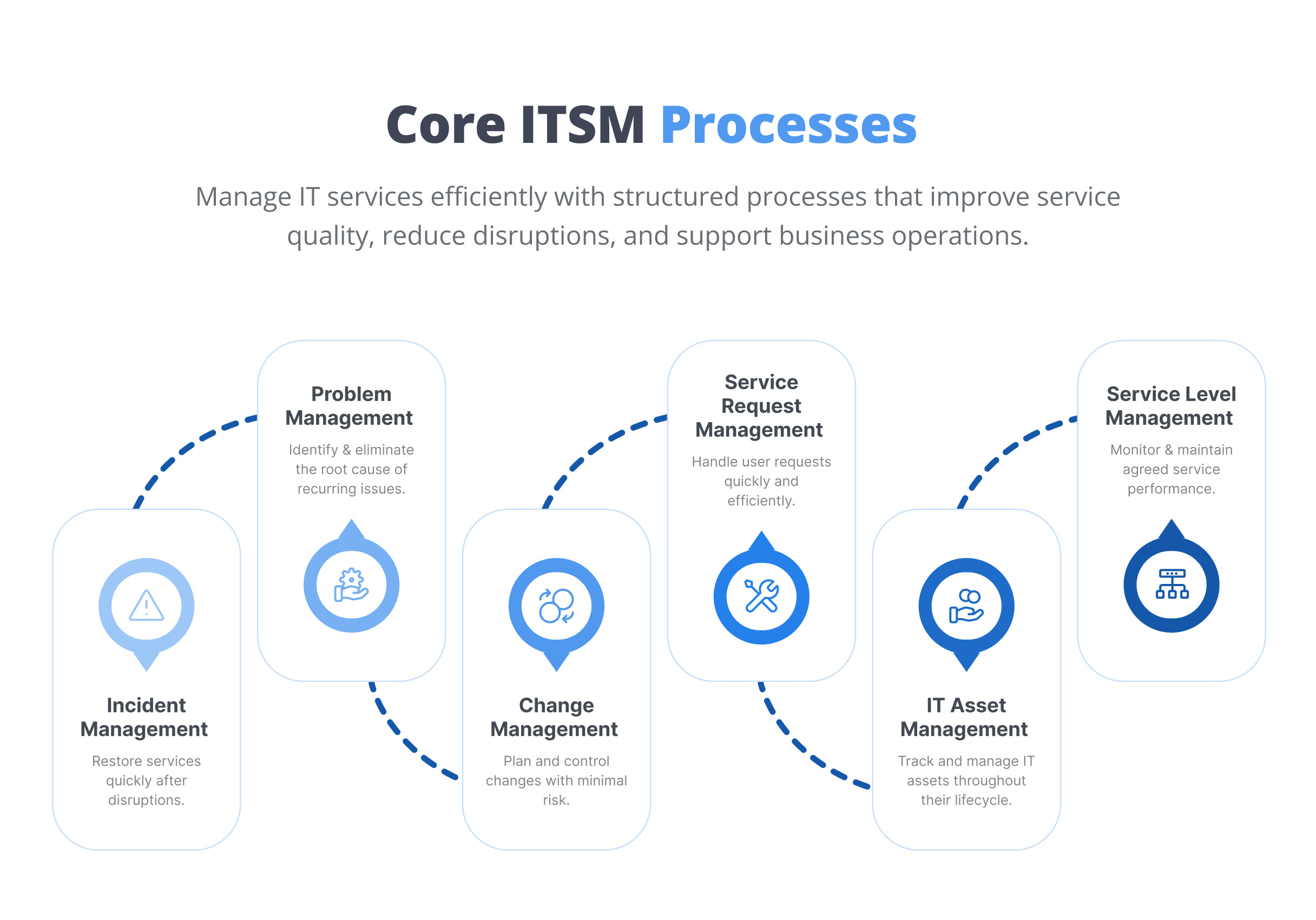
ITSM covers several important processes, including:
- Incident management
- Problem management
- Change management
- Service request management
- IT asset management
- Configuration management
- Service level management
These processes help organisations deliver reliable, secure, and high-quality IT services that support digital transformation.
How does ITSM support digital transformation?
Digital transformation requires businesses to introduce new technologies, applications, and workflows without disrupting existing operations. ITSM provides the structure and governance needed to manage these changes and keep transformation on track.
ITSM supports digital transformation in several ways.
Standardises IT processes
Digital transformation often introduces multiple technologies across different departments. Without standardised processes, managing these technologies becomes difficult.
ITSM creates consistent workflows for handling incidents, requests, changes, and approvals, helping digital transformation run more smoothly across the organisation.
Improves service delivery
Employees expect quick resolutions when technical issues arise. Delays can directly affect productivity and customer service.
ITSM enables organisations to
- Resolve incidents faster
- Track service requests efficiently
- Prioritise critical issues
- Improve communication between IT teams and users
This results in a better experience for both employees and customers, supporting the goals of digital transformation.
Supports automation
Manual IT processes consume valuable time and resources. ITSM platforms automate repetitive tasks such as:
- Ticket creation
- Request approvals
- Incident routing
- Notifications
- Escalations
Automation reduces human errors while improving response times, helping organisations support digital transformation more effectively.
Simplifies change management
Digital transformation involves continuous updates, software deployments, and infrastructure improvements.
ITSM ensures that every change is planned, reviewed, tested, and implemented with minimal business disruption.
This reduces risks while maintaining service availability, which is essential during digital transformation.
Enhances IT asset management
Businesses rely on various IT assets such as laptops, servers, software, cloud resources, and licenses.
ITSM helps organisations
- Track IT assets
- Monitor asset lifecycle
- Manage software licenses
- Reduce asset-related risks
- Improve resource utilisation
Effective IT asset management supports better budgeting and planning during digital transformation, helping organisations manage change with greater control.
Provides better visibility
Modern ITSM platforms include dashboards and reporting tools that provide visibility into IT operations.
Businesses can monitor
- Service performance
- Incident trends
- Asset health
- SLA compliance
- Team productivity
This helps decision-makers identify improvement opportunities more effectively and guide digital transformation with greater confidence.
ITSM vs traditional IT support
| Traditional IT Support | IT Service Management |
|---|---|
| Focuses mainly on fixing issues | Focuses on delivering end-to-end IT services |
| Reactive approach | Proactive and strategic approach |
| Limited process standardisation | Standardised workflows and best practices |
| Manual service handling | Automated service management |
| Basic ticket management | Complete lifecycle management of IT services |
| Limited reporting | Real-time dashboards and analytics |
| Supports day-to-day operations | Supports long-term digital transformation goals |
Key features to look for in an ITSM solution
Choosing the right ITSM solution is essential for successful digital transformation.
Look for features such as:
- Service desk management
- Incident management
- Problem management
- Change management
- IT asset management
- Service catalogue
- SLA management
- Workflow automation
- Self-service portal
- Dashboards and reporting
- API integrations
- Role-based access control
A comprehensive ITSM platform simplifies IT operations while supporting business growth and digital transformation.
Why choose iServe for your digital transformation journey?
If your organisation is planning its digital transformation journey, the right ITSM solution can make all the difference.
iServe by CATS4U is a comprehensive IT Service Management and IT Asset Management platform designed to help organisations simplify IT operations, automate workflows, and improve service delivery.
With iServe, businesses can efficiently manage service requests, monitor IT assets, streamline approvals, and gain complete visibility into their IT environment, supporting digital transformation.
Key features of iServe:
- Automatic impact analysis
- Interactive dashboards
- Integrated activity reports
- Client self-service portal
- Satisfaction surveys
- User profile management
- Complete change history
- REST/JSON API integration
- Service catalogue & SLA management
- Coverage window definition
- Mail-to-ticket automation
- IT asset & IP management
- Automated report generation
Digital transformation is not simply about adopting new technologies. It is about creating smarter, faster, and more efficient ways of working.
Technology alone cannot deliver successful transformation. Organisations also need structured processes to manage services, support users, handle changes, and maintain IT assets effectively.
This is where ITSM becomes an essential part of the journey. By standardising IT operations, automating workflows, improving service delivery, and providing greater visibility, ITSM helps organisations move through digital transformation with confidence.
If you’re looking for a reliable ITSM solution to modernise your IT operations, iServe by CATS4U provides the tools you need to simplify service management, improve operational efficiency, and support your digital transformation journey.
Frequently asked questions
Digital transformation is the process of integrating digital technologies into business operations to improve efficiency, customer experiences, collaboration, and decision-making.
IT Service Management is a structured approach to designing, delivering, managing, and improving IT services so they align with business objectives.
ITSM supports digital transformation by standardising IT processes, automating workflows, managing IT assets, improving service delivery, and ensuring smooth implementation of technological changes.
IT asset management helps organisations monitor hardware, software, licenses, and other IT resources throughout their lifecycle. It improves resource utilisation, reduces costs, and supports better planning.
Some major benefits include:
- Improved service delivery
- Faster incident resolution
- Better IT asset visibility
- Workflow automation
- Increased operational efficiency
- Enhanced customer and employee satisfaction
- Better compliance and governance
No. Businesses of all sizes can benefit from ITSM. Small and medium-sized organisations can use ITSM to streamline IT operations, improve service quality, and support future growth.
