


Managing IT services well is essential for organisational success in today's ever-evolving business world. As companies expand and adapt, the complexity of their IT infrastructure grows, demanding a robust solution to handle various IT processes.
Traditional methods of IT Service Management (ITSM) often fail to address the dynamic needs of modern enterprises. This guide explores a transformative approach that leverages advanced technologies to optimise IT operations, offering scalable and flexible solutions that align with contemporary business requirements.
By embracing this innovative model, companies can enhance their IT service delivery, reduce costs, and improve overall efficiency, to name a few. Let's understand ITSM as a Service in depth.
ITSM: Objective
ITSM manages and supports IT services from start to finish, ensuring they meet business goals and provide value. It coordinates many processes essential for daily operations — supporting operations everywhere, automating tasks, and offering access to top-quality technology.
Efficiency and productivity
ITSM standardises and optimises IT service delivery, improving efficiency and employee productivity.
Cost management
Creates a predictable IT environment, lowering costs through better resource management.
Insights
ITSM provides valuable data that helps in making business decisions.
Consistent service delivery
ITSM ensures IT services are reliable, secure, and meet user expectations.
Scalability
Proper ITSM processes and technology enable organisations to expand IT operations as business needs growth.
What is ITSM as a Service (ITSMaaS)?
ITSMaaS is a third-party service that offers IT service management capabilities, helping your company avoid the costs of setting up and maintaining an in-house system. In traditional ITSM, you manage and configure your systems on-site or in private data centers. This gives you complete control over the infrastructure and customisation. With ITSMaaS, a service provider manages your IT service needs using their expertise and infrastructure.
Why choose ITSMaaS solutions?
ITSMaaS solutions follow the latest ITIL guidelines, covering three layers of management practice:
General management practices
Overall management of your organisation, including services and business functions. They focus on leadership, communication, strategy, planning, and continuous improvement.
- Strategy management
- Portfolio management
- Architecture management
- Service financial management
- Workforce and talent management
- Continual improvement
- Measurement and reporting
- Risk management
- Information security management
- Knowledge management
- Organisational change management
- Project management
- Relationship management
- Supplier management
Service management practices
Principles and activities designed for developing, deploying, delivering, and supporting individual services. They address the specific needs and characteristics of each service.
- Business analysis
- Service catalog management
- Service design
- Service level management
- Availability management
- Capacity and performance management
- Service continuity management
- Monitoring and event management
- Service desk
- Incident management
- Service request management
- Problem management
- Release management
- Change enablement
- Service validation and testing
- Service configuration management
- IT asset management
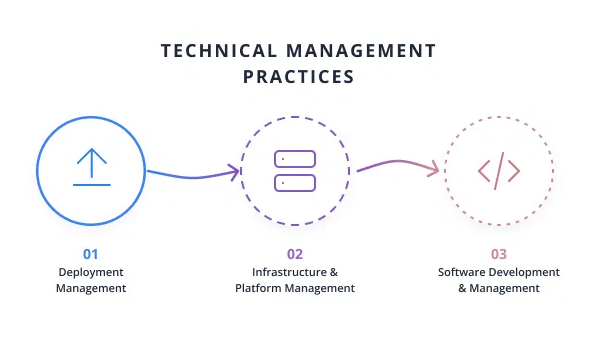
Technical management practices
Adapted from technology management domains for service management, focused on the technical layer beneath your IT services.
ITSM frameworks
ITSM frameworks offer structured methods to manage IT services, ensuring consistency and quality. They align IT with business goals and improve efficiency. Here are the ones you'll meet most often:
Information Technology Infrastructure Library (ITIL)
ITIL is the most widely used ITSM framework. It provides best practices for aligning IT services with business needs. It covers the entire service lifecycle, including incident, problem, and change management. Many organisations use ITIL for self-service and service catalogs. ITSM services following ITIL processes help maintain employee productivity and meet business needs.
Capability Maturity Model Integration (CMMI)
CMMI helps organisations improve processes by providing best practices for developing and maintaining products. It assesses process maturity to ensure excellent final products. CMMI is easy to use, flexible, and compatible with other methods.
Six Sigma
Six Sigma uses data to improve processes and achieve high operational standards. Its goal is to eliminate errors by identifying and fixing the root causes of problems. Six Sigma improves IT service quality and efficiency through its Define, Measure, Analyse, Improve, and Control (DMAIC) methodology.
Control Objectives for Information and Related Technologies (COBIT)
COBIT is a comprehensive framework for managing and governing enterprise IT. It aligns IT goals with business objectives, ensures compliance, and optimises IT investments. COBIT provides best practices for IT control and management and integrates well with other frameworks.
Enhanced Telecom Operations Map (eTOM)
eTOM caters to the telecommunications industry with standardised processes and a common language.
ISO/IEC 20000
ISO/IEC 20000 is an international standard for managing IT services. It guides service providers in planning, implementing, operating, monitoring, reviewing, maintaining, and improving their service systems. This standard integrates well with other methods and ensures high-quality, reliable services.
The Open Group Architecture Framework (TOGAF)
TOGAF helps organisations develop better IT strategies. It focuses on improving IT systems' design, planning, implementation, and management. By closely linking IT with business goals, TOGAF ensures technology supports overall business objectives and encourages collaboration across the organisation.
DevOps
DevOps promotes close collaboration between teams to improve the creation and management of IT systems. It combines development, operations, and other areas to streamline software updates. DevOps emphasises automation and continuous delivery, making updates faster and more reliable. It fosters a culture of teamwork and continuous improvement, enhancing innovation and customer satisfaction.
Benefits of availing ITSMaaS
ITSMaaS provides a flexible and effective way to streamline IT service management and boost business efficiency. Here's what you get:
Prepare your IT systems for the future
As technology evolves rapidly, having an efficient IT team is essential more than ever. Investing in ITSMaaS and partnering with a reliable provider ensures you stay competitive and keep pace with technological advancements.
If you need IT experts to enhance your operations, consider CATS4U. CATS4U offers iServe, an ideal ITSM solution to support your IT needs. Schedule a consultation with our experts to explore how we can help you access ITSM capabilities.
Frequently asked questions
A service in ITSM is an IT function that supports business needs, like email or customer support.
ITSM is a framework for managing IT services. ServiceNow CSM (Customer Service Management) aims to build customer loyalty.
An ITSM solution is a set of tools and processes designed to effectively manage and deliver IT services.
Incident management is an example where IT issues are identified, logged, and resolved.
There are numerous ITSM solutions available. The best ITSM solution depends on your needs. One such solution you can consider is iServe by CATS4U. Contact us to know more.
